


Page 88 - English_Spark_8
P. 88
ways nature might possibly coexist with technology. At one point, I drew a picture of a

            robot on a tree. Suddenly, my imagination was flooded with ideas for a story about a
            robot finding harmony in the wilderness. I didn’t realise at that time that I was on my

            way to writing my first children’s novel.

               Why did you select a robot?

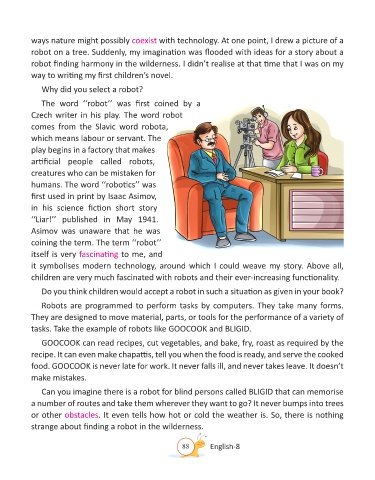
               The  word  ‘‘robot’’  was  first  coined  by  a
            Czech writer in his play. The word robot

            comes  from  the  Slavic  word  robota,
            which means labour or servant. The

            play begins in a factory that makes
            artificial  people  called  robots,

            creatures who can be mistaken for
            humans. The word ‘‘robotics’’ was

            first used in print by Isaac Asimov,
            in  his  science  fiction  short  story

            ‘‘Liar!’’  published  in  May  1941.
            Asimov  was  unaware  that  he  was

            coining the term. The term ‘‘robot’’
            itself is very fascinating to me, and

            it symbolises modern technology, around which I could weave my story. Above all,
            children are very much fascinated with robots and their ever-increasing functionality.


               Do you think children would accept a robot in such a situation as given in your book?
               Robots are programmed to perform tasks by computers. They take many forms.

            They are designed to move material, parts, or tools for the performance of a variety of

            tasks. Take the example of robots like GOOCOOK and BLIGID.
               GOOCOOK can read recipes, cut vegetables, and bake, fry, roast as required by the

            recipe. It can even make chapattis, tell you when the food is ready, and serve the cooked

            food. GOOCOOK is never late for work. It never falls ill, and never takes leave. It doesn’t
            make mistakes.

               Can you imagine there is a robot for blind persons called BLIGID that can memorise

            a number of routes and take them wherever they want to go? It never bumps into trees
            or other obstacles. It even tells how hot or cold the weather is. So, there is nothing

            strange about finding a robot in the wilderness.


                                                                88        English-8

