


Page 97 - English_Spark_8
P. 97
in  science and  technology

            have  brought  to  continue,  but
            it also distrusts science because

            it does not understand it.  This
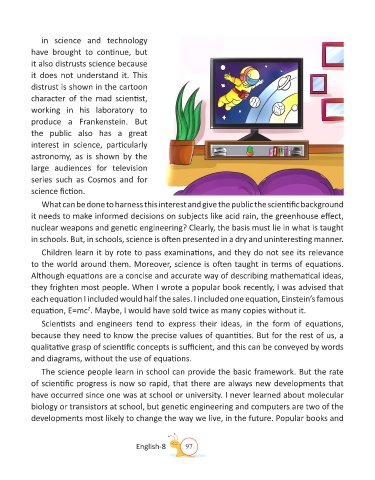
            distrust is shown in the cartoon

            character  of  the  mad  scientist,
            working  in  his  laboratory  to

            produce  a  Frankenstein.  But
            the  public  also  has  a  great

            interest  in  science,  particularly
            astronomy,  as  is  shown  by  the

            large  audiences  for  television
            series  such  as  Cosmos  and  for

            science fiction.

               What can be done to harness this interest and give the public the scientific background
            it needs to make informed decisions on subjects like acid rain, the greenhouse effect,

            nuclear weapons and genetic engineering? Clearly, the basis must lie in what is taught
            in schools. But, in schools, science is often presented in a dry and uninteresting manner.

               Children learn it by rote to pass examinations, and they do not see its relevance

            to the world around them. Moreover, science is often taught in terms of equations.
            Although equations are a concise and accurate way of describing mathematical ideas,
            they frighten most people. When I wrote a popular book recently, I was advised that

            each equation I included would half the sales. I included one equation, Einstein’s famous

            equation, E=mc . Maybe, I would have sold twice as many copies without it.
                               2
               Scientists  and  engineers  tend  to  express  their  ideas,  in  the  form  of  equations,

            because they need to know the precise values of quantities. But for the rest of us, a
            qualitative grasp of scientific concepts is sufficient, and this can be conveyed by words

            and diagrams, without the use of equations.

               The science people learn in school can provide the basic framework. But the rate
            of scientific progress is now so rapid, that there are always new developments that

            have occurred since one was at school or university. I never learned about molecular
            biology or transistors at school, but genetic engineering and computers are two of the

            developments most likely to change the way we live, in the future. Popular books and


                                                English-8        97

