


Page 17 - General_Knowledge_7
P. 17
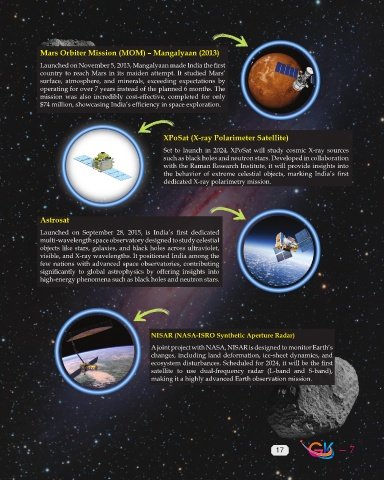
Mars Orbiter Mission (MOM) – Mangalyaan (2013)

               Launched on November 5, 2013, Mangalyaan made India the first
               country to reach Mars in its maiden attempt. It studied Mars’
               surface,  atmosphere,  and  minerals,  exceeding  expectations  by
               operating for over 7 years instead of the planned 6 months. The
               mission  was  also  incredibly  cost-effective,  completed  for  only
               $74 million, showcasing India’s efficiency in space exploration.


                                                        XPoSat (X-ray Polarimeter Satellite)

                                                        Set to launch in 2024, XPoSat will study cosmic X-ray sources
                                                        such as black holes and neutron stars. Developed in collaboration
                                                        with the Raman Research Institute, it will provide insights into
                                                        the  behavior  of  extreme  celestial  objects,  marking  India’s  first
                                                        dedicated X-ray polarimetry mission.


               Astrosat

               Launched  on  September  28,  2015,  is  India’s  first  dedicated
               multi-wavelength space observatory designed to study celestial
               objects like stars, galaxies, and black holes across ultraviolet,
               visible, and X-ray wavelengths. It positioned India among the
               few nations with advanced space observatories, contributing
               significantly  to  global  astrophysics  by  offering  insights  into
               high-energy phenomena such as black holes and neutron stars.


                                                    NISAR (NASA-ISRO Synthetic Aperture Radar)
                                                    A joint project with NASA, NISAR is designed to monitor Earth’s
                                                    changes, including land deformation, ice-sheet dynamics, and
                                                    ecosystem disturbances. Scheduled for 2024, it will be the first
                                                    satellite  to  use  dual-frequency  radar  (L-band  and  S-band),
                                                    making it a highly advanced Earth observation mission.


                                                                                              17                   — 7

