


Page 76 - General_Knowledge_8
P. 76
Enlighten Me!


              Dealing With the Potential Danger of  a Meteor Hitting Earth


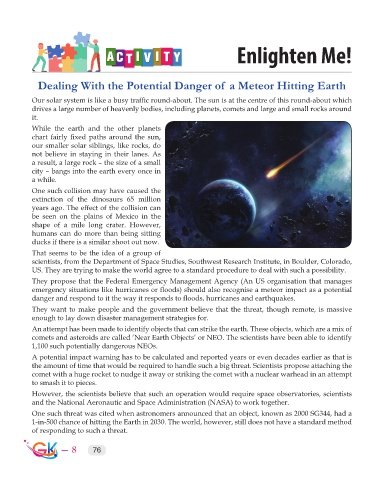
            Our solar system is like a busy traffic round-about. The sun is at the centre of this round-about which
            drives a large number of heavenly bodies, including planets, comets and large and small rocks around
            it.
            While  the  earth  and  the  other  planets
            chart fairly fixed paths around the sun,
            our smaller solar siblings, like rocks, do
            not believe in staying in their lanes. As
            a result, a large rock – the size of a small
            city – bangs into the earth every once in
            a while.
            One such collision may have caused the
            extinction  of  the  dinosaurs  65  million
            years ago. The effect of the collision can
            be  seen  on  the  plains  of  Mexico  in  the
            shape  of  a  mile  long  crater.  However,
            humans can do more than being sitting
            ducks if there is a similar shoot out now.
            That seems to be the idea of a group of
            scientists, from the Department of Space Studies, Southwest Research Institute, in Boulder, Colorado,
            US. They are trying to make the world agree to a standard procedure to deal with such a possibility.
            They propose that the Federal Emergency Management Agency (An US organisation that manages
            emergency situations like hurricanes or floods) should also recognise a meteor impact as a potential
            danger and respond to it the way it responds to floods, hurricanes and earthquakes.
            They want to make people and the government believe that the threat, though remote, is massive
            enough to lay down disaster management strategies for.
            An attempt has been made to identify objects that can strike the earth. These objects, which are a mix of
            comets and asteroids are called ‘Near Earth Objects’ or NEO. The scientists have been able to identify
            1,100 such potentially dangerous NEOs.
            A potential impact warning has to be calculated and reported years or even decades earlier as that is
            the amount of time that would be required to handle such a big threat. Scientists propose attaching the
            comet with a huge rocket to nudge it away or striking the comet with a nuclear warhead in an attempt
            to smash it to pieces.
            However, the scientists believe that such an operation would require space observatories, scientists
            and the National Aeronautic and Space Administration (NASA) to work together.
            One such threat was cited when astronomers announced that an object, known as 2000 SG344, had a
            1-in-500 chance of hitting the Earth in 2030. The world, however, still does not have a standard method
            of responding to such a threat.


                     — 8        76

