


Page 49 - General_Knowledge_5
P. 49
Enlighten Me!


                   Why do the Sun and Moon follow you when you travel?


            Have you ever noticed that when you are in a car, or a bus, travelling on a straight road,
            the Sun appears to move right along with you?

            While telephone poles and trees close to the road, whiz past in the blink of an eye, the Sun
            is always visible throughout the journey. No matter how fast you drive, you just cannot
            leave the Sun behind.


            Strangely enough, the trees nearer the road disappear from                                  A
            your range of vision more quickly than the trees further off.
            Why is this so?
                                                                                               D               E
            Our eyes have a certain ‘range’ of vision. You can see things

            only within that range. For instance, you cannot see objects
            behind your head. This field of vision widens out from the                   B                            C
            point where you are. Objects further away are visible for a                             (Fig. 1)
            longer period, even as your car whizzes by.

            Field of vision


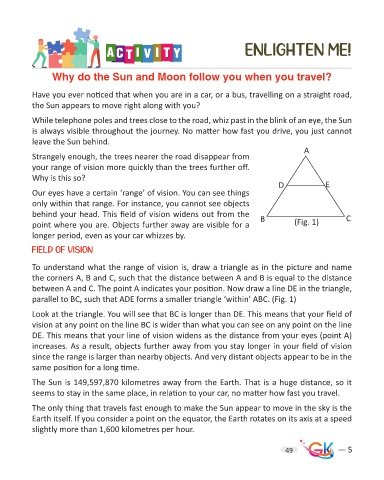
            To understand what the range of vision is, draw a triangle as in the picture and name
            the corners A, B and C, such that the distance between A and B is equal to the distance

            between A and C. The point A indicates your position. Now draw a line DE in the triangle,
            parallel to BC, such that ADE forms a smaller triangle ‘within’ ABC. (Fig. 1)

            Look at the triangle. You will see that BC is longer than DE. This means that your field of
            vision at any point on the line BC is wider than what you can see on any point on the line
            DE. This means that your line of vision widens as the distance from your eyes (point A)

            increases. As a result, objects further away from you stay longer in your field of vision
            since the range is larger than nearby objects. And very distant objects appear to be in the
            same position for a long time.

            The Sun is 149,597,870 kilometres away from the Earth. That is a huge distance, so it

            seems to stay in the same place, in relation to your car, no matter how fast you travel.

            The only thing that travels fast enough to make the Sun appear to move in the sky is the
            Earth itself. If you consider a point on the equator, the Earth rotates on its axis at a speed
            slightly more than 1,600 kilometres per hour.


                                                                                                 49                — 5

