


Page 6 - Digital_Kids_5
P. 6
and multiplication of numbers. Later, it was improved to perform division and even to
            calculate square roots.


            Pascaline

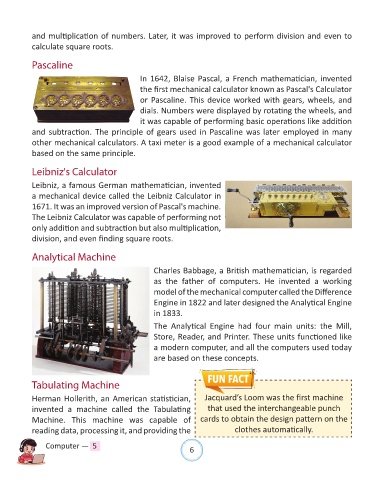
                                                In 1642, Blaise Pascal, a French mathematician, invented

                                                the first mechanical calculator known as Pascal's Calculator
                                                or Pascaline. This device worked with gears, wheels, and
                                                dials. Numbers were displayed by rotating the wheels, and
                                                it was capable of performing basic operations like addition
            and subtraction. The principle of gears used in Pascaline was later employed in many

            other mechanical calculators. A taxi meter is a good example of a mechanical calculator
            based on the same principle.


            Leibniz's Calculator

            Leibniz, a famous German mathematician, invented
            a mechanical device called the Leibniz Calculator in
            1671. It was an improved version of Pascal's machine.
            The Leibniz Calculator was capable of performing not

            only addition and subtraction but also multiplication,
            division, and even finding square roots.


            Analytical Machine

                                                     Charles Babbage, a British mathematician, is regarded
                                                     as  the  father  of  computers.  He  invented  a  working
                                                     model of the mechanical computer called the Difference
                                                     Engine in 1822 and later designed the Analytical Engine

                                                     in 1833.
                                                     The  Analytical  Engine  had  four  main  units:  the  Mill,

                                                     Store, Reader, and Printer. These units functioned like
                                                     a modern computer, and all the computers used today
                                                     are based on these concepts.


            Tabulating Machine

            Herman Hollerith, an American statistician,               Jacquard’s Loom was the first machine
            invented  a  machine  called  the  Tabulating              that used the interchangeable punch
            Machine.  This  machine  was  capable  of  cards to obtain the design pattern on the

            reading data, processing it, and providing the                      clothes automatically.

                Computer —  5                                    6

