


Page 7 - Digital_Kids_5
P. 7
desired output. The input was given through punched cards, which were used to record
            and store data or information.


            The First Electro-Mechanical Computer

            Mark I — In 1944, Prof. Howard Aiken built the first electro-mechanical computer, known

            as Mark I. This machine was 51 feet long, weighed 5 tons, and used a typewriter for input
            and punched cards for output. The Mark I is considered the first real computer in history.


            The First Electronic Computers
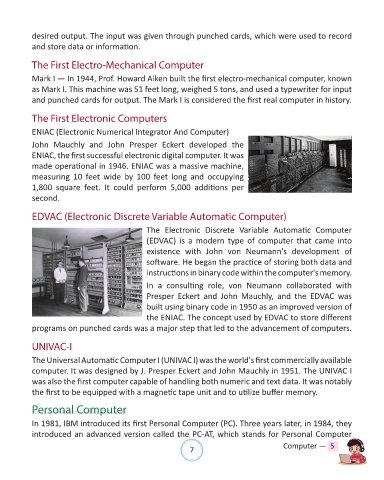
            ENIAC (Electronic Numerical Integrator And Computer)

            John  Mauchly  and  John  Presper  Eckert  developed  the
            ENIAC, the first successful electronic digital computer. It was

            made operational in 1946. ENIAC was a massive machine,
            measuring  10  feet  wide  by  100  feet  long  and  occupying
            1,800  square  feet.  It  could  perform  5,000  additions  per
            second.


            EDVAC (Electronic Discrete Variable Automatic Computer)

                                                  The  Electronic  Discrete  Variable  Automatic  Computer
                                                  (EDVAC)  is  a  modern  type  of  computer  that  came  into

                                                  existence  with  John  von  Neumann's  development  of
                                                  software. He began the practice of storing both data and
                                                  instructions in binary code within the computer's memory.

                                                  In  a  consulting  role,  von  Neumann  collaborated  with
                                                  Presper  Eckert  and  John  Mauchly,  and  the  EDVAC  was
                                                  built using binary code in 1950 as an improved version of

                                                  the ENIAC. The concept used by EDVAC to store different
            programs on punched cards was a major step that led to the advancement of computers.


            UNIVAC-I

            The Universal Automatic Computer I (UNIVAC I) was the world's first commercially available
            computer. It was designed by J. Presper Eckert and John Mauchly in 1951. The UNIVAC I
            was also the first computer capable of handling both numeric and text data. It was notably
            the first to be equipped with a magnetic tape unit and to utilize buffer memory.


            Personal Computer

            In 1981, IBM introduced its first Personal Computer (PC). Three years later, in 1984, they
            introduced an advanced version called the PC-AT, which stands for Personal Computer


                                                                 7                               Computer —  5

