


Page 9 - Digital_Kids_5
P. 9
reliable.

            They used magnetic cores for primary memory and magnetic tapes and disks for secondary
            storage. The programming languages of this era included Assembly language, as well as
            early high-level languages like COBOL and FORTRAN.

            Input  was  typically  done  via  a  keyboard,  and  output  was  shown  on  a  monitor.  These
            computers were still quite large, often the size of a small room.

            Examples: IBM 1401 and PDP-8.


            The Third Generation of Computers (1965-1970)

            The Third Generation of Computers emerged in the mid-
            1960s  with  the  invention  of  the  Integrated  Circuit  (IC),
            also known as a semiconductor chip. This new technology

            replaced transistors, making these computers significantly
            more powerful, faster, and efficient.

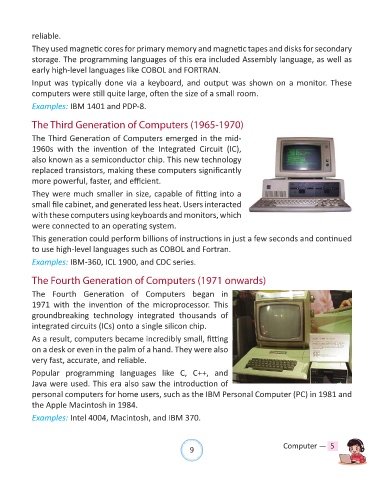
            They were much smaller in size, capable of fitting into a
            small file cabinet, and generated less heat. Users interacted
            with these computers using keyboards and monitors, which
            were connected to an operating system.

            This generation could perform billions of instructions in just a few seconds and continued
            to use high-level languages such as COBOL and Fortran.

            Examples: IBM-360, ICL 1900, and CDC series.


            The Fourth Generation of Computers (1971 onwards)

            The  Fourth  Generation  of  Computers  began  in
            1971  with  the  invention  of  the  microprocessor.  This
            groundbreaking  technology  integrated  thousands  of
            integrated circuits (ICs) onto a single silicon chip.

            As a result, computers became incredibly small, fitting
            on a desk or even in the palm of a hand. They were also

            very fast, accurate, and reliable.
            Popular  programming  languages  like  C,  C++,  and

            Java were used. This era also saw the introduction of
            personal computers for home users, such as the IBM Personal Computer (PC) in 1981 and
            the Apple Macintosh in 1984.

            Examples: Intel 4004, Macintosh, and IBM 370.


                                                                 9                               Computer —  5

