


Page 8 - Digital_Kids_5
P. 8
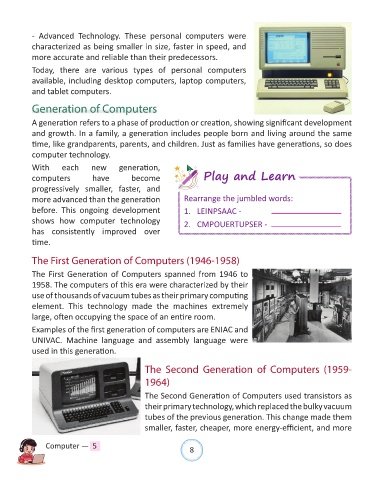
-  Advanced  Technology.  These  personal  computers  were
            characterized as being smaller in size, faster in speed, and

            more accurate and reliable than their predecessors.
            Today,  there  are  various  types  of  personal  computers

            available, including desktop computers, laptop computers,
            and tablet computers.

            Generation of Computers

            A generation refers to a phase of production or creation, showing significant development

            and growth. In a family, a generation includes people born and living around the same
            time, like grandparents, parents, and children. Just as families have generations, so does
            computer technology.

            With      each      new      generation,
            computers           have         become                   Play and Learn
            progressively  smaller,  faster,  and

            more advanced than the generation                  Rearrange the jumbled words:
            before.  This  ongoing  development                1.  LEINPSAAC -
            shows  how  computer  technology                   2.  CMPOUERTUPSER -

            has  consistently  improved  over
            time.


            The First Generation of Computers (1946-1958)
            The First Generation of Computers spanned from 1946 to

            1958. The computers of this era were characterized by their
            use of thousands of vacuum tubes as their primary computing
            element.  This  technology  made  the  machines  extremely

            large, often occupying the space of an entire room.
            Examples of the first generation of computers are ENIAC and
            UNIVAC.  Machine  language  and  assembly  language  were

            used in this generation.

                                                  The Second Generation of Computers (1959-

                                                  1964)

                                                  The Second Generation of Computers used transistors as
                                                  their primary technology, which replaced the bulky vacuum

                                                  tubes of the previous generation. This change made them
                                                  smaller, faster, cheaper, more energy-efficient, and more


                Computer —  5                                    8

