


Page 13 - Digital_Kids_5
P. 13
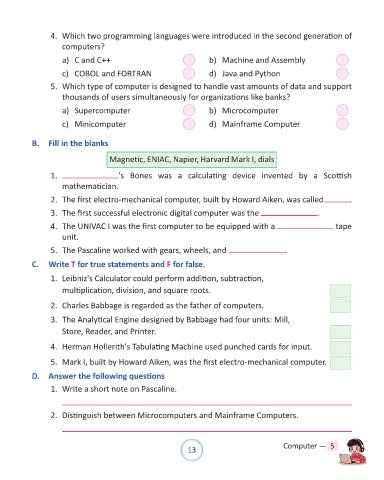
4.  Which two programming languages were introduced in the second generation of
                      computers?

                      a)  C and C++                                     b)  Machine and Assembly

                      c)  COBOL and FORTRAN                             d)  Java and Python

                  5.  Which type of computer is designed to handle vast amounts of data and support
                      thousands of users simultaneously for organizations like banks?

                      a)  Supercomputer                                 b)  Microcomputer

                      c)  Minicomputer                                  d)  Mainframe Computer


            B.  Fill in the blanks

                                      Magnetic, ENIAC, Napier, Harvard Mark I, dials


                  1.                     's  Bones  was  a  calculating  device  invented  by  a  Scottish
                      mathematician.

                  2.  The first electro-mechanical computer, built by Howard Aiken, was called                         .

                  3.  The first successful electronic digital computer was the                              .
                  4.  The UNIVAC I was the first computer to be equipped with a                                    tape

                      unit.

                  5.  The Pascaline worked with gears, wheels, and                               .
            C.  Write T for true statements and F for false.

                  1.  Leibniz's Calculator could perform addition, subtraction,

                      multiplication, division, and square roots.

                  2.  Charles Babbage is regarded as the father of computers.

                  3.  The Analytical Engine designed by Babbage had four units: Mill,

                      Store, Reader, and Printer.

                  4.  Herman Hollerith's Tabulating Machine used punched cards for input.

                  5.  Mark I, built by Howard Aiken, was the first electro-mechanical computer.

            D.  Answer the following questions

                  1.  Write a short note on Pascaline.


                  2.  Distinguish between Microcomputers and Mainframe Computers.


                                                                13                               Computer —  5

